
Deterministic planning tool · fixture 1.0.0
RV 12V daily load calculator
Enter actual label, measured, or explicitly estimated ratings. Synthetic Load A/B values demonstrate the fixture; they are not appliance presets.
| Load / provenance | Rating | Qty | Hours/day | Duty low–high | Daily result | Remove |
|---|---|---|---|---|---|---|
| –% | — | |||||
| –% | — |
Use the same stated voltage for amp-to-watt and Wh-to-Ah conversion. For a known steady load, set low and high duty to the same value.
Estimated daily 12V energy
Calculating...
High-estimate contribution by load
Deterministic example fixtures
- mixed-rating-range: 174.4–225.6 Wh/day at 12.8V
- single-steady-watt-load: 180–180 Wh/day at 12V
Use the calculator above to turn a row-by-row 12V load inventory into a daily energy range. It accepts either amps or watts, but each active row must identify the rating as label, measured, or estimated. That provenance matters: a neat total built from undocumented guesses is still a guess.
The result reports watt-hours per day and amp-hours per day at the voltage you entered. It also shows which loads dominate the high estimate, exports the audit as CSV, and passes the high daily watt-hour estimate to the RV battery runtime calculator.
Safety and limitations: This is an energy-planning tool, not a wiring, fuse, conductor, battery, inverter, solar-array, or installation approval. It does not model starting surge, fault current, voltage drop, temperature, battery-management limits, converter behavior, or product-specific operating limits. Stop and use qualified help for damaged equipment, overheating, burning smells, arcing, exposed conductors, or work involving shore-power mains voltage.
Build the 12V load inventory
Start with the actual equipment in the RV. Record one row for each distinct operating behavior, not merely each product category. Two identical lights can share a row by increasing quantity, but a refrigerator control board and a compressor supplied through an inverter do not belong in one generic “fridge” row if their power paths and duty cycles differ.
For every row, collect:
| Field | What to enter | Common error to avoid |
|---|---|---|
| Load name | A name that identifies the installed device or circuit | Using a vague category that cannot be checked later |
| Provenance | Label, measured, or estimated | Leaving an approximate table value looking like a measurement |
| Rating | Amps or watts from the same documented operating state | Mixing a startup rating with normal running demand |
| Quantity | Number of equivalent loads represented by the row | Counting the same device both individually and in a group |
| Hours per day | The daily observation window in which the load may operate | Entering 24 hours when the device is only available for a shorter period |
| Duty low-high | Fraction of those hours the load is active | Applying duty cycle twice by reducing both hours and duty for the same off-time |
Use an equipment label or manual when it specifies the relevant running condition. Use a suitable measurement when the load varies or the label does not represent normal use. An estimate is acceptable for early planning, but keep it marked estimated and widen the duty range. Grand Design’s Imagine owner’s manual labels its load table as approximate and tells owners to check the specific appliance. That is the right role for a generic table: discovery, not proof of your installed load.
The system-voltage input is part of the calculation, not decoration. When a row is entered in amps, the tool first normalizes it to watts:
row watts = entered amps × system voltage
If the equipment’s current rating applies at a specified voltage, use that documented basis or enter a documented watt value. Do not assume every regulated electronic load changes linearly with bus voltage. A meter reading also belongs to the voltage and operating state at which it was taken.
The default rows named Load A and Load B are synthetic fixture data. They demonstrate one amp-rated row, one watt-rated row, and a duty-cycle range; they are not typical ratings for any appliance. Replace or remove both before using the total for planning.
For a cycling load, define low and high duty assumptions that describe the same daily conditions. A 25%-50% range means the device is expected to run for one-quarter to one-half of its entered hours, not that its power rating is uncertain by the same percentage. If the load is continuously on throughout the entered hours, use 100%-100%.
Audit the daily energy result
The tool calculates each row in three visible steps:
row watts = amps × stated voltage when the row uses amps
row Wh/day = watts × quantity × hours/day × duty fraction
row Ah/day = row Wh/day ÷ stated voltage
Power and energy are different quantities. Watts describe the rate at which energy is used; watt-hours describe that power accumulated over time. Victron’s Energy Unlimited presents the same relationships: energy as power multiplied by time and watt-hours as volts multiplied by amp-hours. Stating the voltage is therefore essential when converting between Wh and Ah.
The total is the sum of the valid rows. The low total uses every row’s low duty assumption; the high total uses every row’s high assumption. It is a scenario range, not a statistical confidence interval. If several loads become more active under the same condition, for example hot weather, the high scenario is often more informative than treating each row as independent.
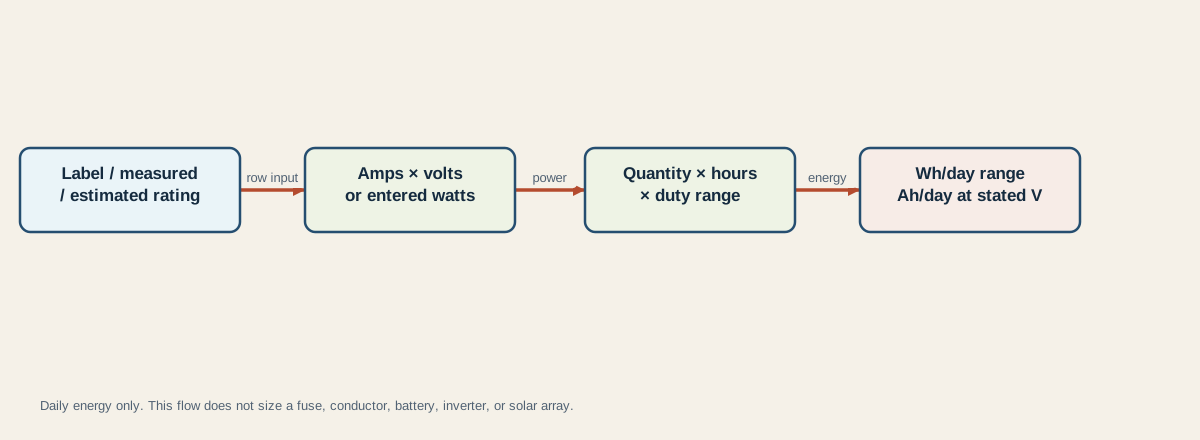
The diagram and interactive result deliberately end at daily Wh and Ah. The chart beneath the result allocates the high Wh/day estimate by row so that optimization work starts with the largest contributors rather than the easiest devices to notice.
Worked fixture: mixed-rating-range
The verified fixture uses a 12.8V basis. Its synthetic Load A is 2A, quantity 2, four hours per day, and 50%-75% duty. The normalized power per device is 25.6W, producing 102.4-153.6 Wh/day across both devices. Synthetic Load B is 24W for three hours at 100% duty, producing 72 Wh/day. The combined result is 174.4-225.6 Wh/day, or 13.625-17.625 Ah/day at 12.8V.
You can reproduce those totals row by row:
- Load A low:
2 A × 12.8 V × 2 × 4 h × 0.50 = 102.4 Wh - Load A high:
2 A × 12.8 V × 2 × 4 h × 0.75 = 153.6 Wh - Load B:
24 W × 1 × 3 h × 1.00 = 72 Wh
Worked fixture: single-steady-watt-load
The second fixture uses one synthetic 36W load for five hours at 100% duty. Its result is 180 Wh/day and 15 Ah/day at 12V. The equal low and high values show that a range is not manufactured when the user supplies one fixed duty assumption.
Use Export CSV after replacing the fixture rows. The export preserves the row name, provenance, rating type, rating, quantity, hours, duty range, calculated Wh range, and system voltage. Save it alongside meter notes or manual references so a later reviewer can see why the total changed.
Use Estimate battery runtime only after auditing the rows. That handoff transfers the high Wh/day estimate as demand; it does not transfer battery voltage, capacity, usable-energy limits, reserve, or efficiency. Those are separate inputs in the runtime model.
Keep daily energy separate from protection and sizing
A daily energy total answers “how much energy might these documented loads use in a day?” It does not answer every electrical design question. Each neighboring decision needs different evidence:
| Decision | Why daily Wh/Ah is insufficient | Additional evidence required | Canonical owner |
|---|---|---|---|
| Battery runtime | Runtime depends on nominal energy, actually available energy, reserve, losses, and cutoff behavior | Battery voltage/capacity, manual-backed limits, reserve, and conversion efficiency | RV battery runtime calculator |
| Fuse selection | A fuse protects a conductor and circuit under current and fault conditions, not an average daily energy total | Circuit current, conductor ampacity, equipment instructions, fuse type, and applicable standard | RV 12V fuse candidate checker; do not infer it here |
| Wire size and voltage drop | Voltage drop depends on instantaneous current, conductor material/gauge, route length, and terminations | Maximum circuit current, round-trip length, conductor data, allowable drop, and installation conditions | RV wire-size and voltage-drop checker; audit the conductor separately |
| Inverter selection | An inverter must handle simultaneous running power, startup surge, waveform needs, and DC-side current | AC load combination, surge profile, inverter manual, DC voltage, and installation limits | RV inverter sizing candidate audit; do not infer it here |
| Battery-bank selection | Usable energy and current capability are product- and configuration-specific | Exact battery manuals, series/parallel topology, BMS/current limits, temperature, and reserve policy | Runtime result is an input, not a bank recommendation |
| Solar sizing | Daily production varies with irradiance, orientation, shading, temperature, controller, and system losses | Location/season resource, array geometry, controller limits, and loss assumptions | RV solar sizing candidate audit; do not infer it here |
Renogy’s outdoor solar guide treats energy demand, battery storage, solar production, and losses as connected planning stages. The connection does not make them interchangeable: a 500 Wh daily load does not imply a 500W array, a particular battery capacity, or a fuse size.
The same boundary applies to AC appliances. If an AC load runs from an inverter, entering only its AC nameplate watts ignores inverter standby demand and conversion loss. For a 12V energy inventory, prefer a suitable measurement on the 12V supply side under the relevant operating condition, or document the AC load and inverter loss explicitly in a separate model. Never probe live mains equipment unless you are qualified and using appropriate procedures and instruments.
Treat the result as ready for the next planning step only when:
- Every active row can be traced to a label, measurement, or visibly marked estimate.
- Voltage and operating state match the rating basis.
- Hours and duty cycle describe the same daily scenario without double-counting off-time.
- Major seasonal or operating scenarios have their own saved range.
- The next tool receives only the value it owns; missing surge, current, protection, battery, and production inputs remain missing rather than guessed.
Sources and limitations
The formulas are deterministic energy bookkeeping. Their usefulness is limited by the evidence entered. Equipment behavior can change with voltage, temperature, control mode, aging, and user behavior; cycling loads may be correlated; measurements have uncertainty; and an appliance label may describe a maximum or test condition rather than typical use. The tool does not recommend products, substitute generic appliance values, or certify an electrical system.
Last verified: August 27, 2026. Recheck installed-equipment documentation and measurements whenever the RV, operating pattern, or electrical system changes.