Deterministic planning tool · fixture 1.0.0
RV battery runtime calculator
Enter documented battery and load assumptions. The result is a planning range, not a battery guarantee or installation approval.
Estimated runtime range
Calculating...
- Nominal energy
- —
- Available energy range
- —
- Delivered after efficiency
- —
- Formula
- —
Deterministic example fixtures
- direct-dc-100ah: 7.2–10.8 hours
- inverter-load-200ah: 6.48–9.72 hours
- daily-cycling-load: 1.44–2.16 days
Use the calculator above to estimate a range, then inspect the calculation trace below. It converts nominal battery energy into an available amount, applies conversion efficiency, and divides by either a constant load or a daily energy demand. Every input is visible because runtime changes when any assumption changes. If daily demand is not documented yet, build it first with the RV 12V load calculator.
Safety and limitations: This is planning math, not a battery-health test, wiring approval, load-shedding guarantee, or permission to exceed a battery, BMS, inverter, conductor, fuse, or manufacturer limit. Stop if a battery is hot, swollen, leaking, damaged, or giving unstable readings. Use the installed battery and equipment manuals for operating limits.
Calculate constant-load or daily-use runtime
Choose Constant load when one documented load runs for a period and you want hours. Choose Daily energy use when a group of loads has a measured or estimated daily watt-hour total and you want days. Do not add a daily watt-hour value and a continuous watt value together; they are different demand models.
The calculator requires these inputs:
| Input | Meaning | What must come from your system |
|---|---|---|
| Battery voltage | Nominal voltage used to convert amp-hours to watt-hours | Battery-bank configuration and manufacturer documentation |
| Capacity | Rated amp-hours at the applicable test conditions | Exact battery or bank rating, not a marketing label copied from a different model |
| Available energy low and high | Planning range before reserve is held back | A measured plan or an explicit assumption; chemistry alone is not enough |
| Reserve held back | Portion not assigned to the planned load | Your operating policy, battery limits, and low-voltage cutoff behavior |
| Conversion efficiency | Fraction delivered after an inverter or other conversion stage | Equipment data or a clearly labeled planning assumption |
| Load mode | Constant watts or daily watt-hours | The actual use pattern being modeled |
| Load and duty cycle | Constant-load power and fraction of time active | Metered, labeled, or documented load behavior |
The default values are examples from the shared rv-battery-runtime fixture, not recommendations. The fixture includes direct-DC, inverter-load, and daily-cycling cases so the same formula is exercised across different demand shapes.
For a constant load, the tool reports:
runtime hours = delivered watt-hours ÷ (load watts × duty cycle)
For daily use, it reports:
runtime days = delivered watt-hours ÷ daily watt-hours
If low available energy is greater than or equal to high available energy, or a required energy/load value is zero, the calculator blocks the result. That is deliberate: a precise-looking duration from invalid inputs is worse than a visible “Enter valid inputs” state.
Trace the result from amp-hours to usable watt-hours
The first conversion is nominal energy:
nominal watt-hours = nominal volts × amp-hours
That relationship explains why amp-hours cannot be compared without voltage. A 100 Ah bank at a nominal 12 V represents a different nominal watt-hour figure from a 100 Ah bank at another voltage. The RV electrical system overview provides the bus and source vocabulary used here.
Next, the model applies the available-energy range and reserve:
available watt-hours = nominal watt-hours × available fraction × (1 - reserve fraction)
Finally, it applies conversion efficiency before dividing by demand:
delivered watt-hours = available watt-hours × efficiency fraction
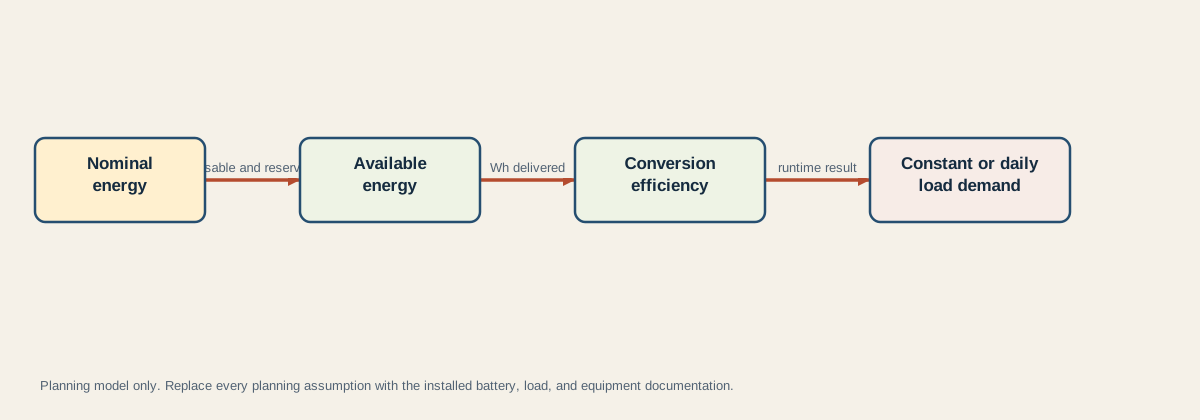
The chart is generated from the same verified fixture that drives the calculator’s example labels and QA cases. It is an energy-accounting map, not a wiring diagram. It does not decide cable size, fuse size, inverter compatibility, battery cutoff, or charging behavior.
Worked fixture: direct-dc-100ah
The fixture uses 12 V, 100 Ah, a 40% to 60% available-energy range, 10% reserve, 100% conversion efficiency, and a 60 W constant load. The nominal energy is 1,200 Wh. After the available-energy and reserve assumptions, the delivered range is 432 Wh to 648 Wh. Dividing by 60 W produces 7.2 to 10.8 hours. The page does not claim that every 100 Ah battery will produce that result; changing chemistry, temperature, age, load, cutoff, or efficiency changes the result.
Worked fixture: daily-cycling-load
The daily fixture uses the same nominal battery inputs, 300 Wh per day, and the same planning range. Its 432 Wh to 648 Wh delivered range produces 1.44 to 2.16 days. That is a planning result for the documented daily demand, not a prediction that the RV can run indefinitely or that the battery should be discharged to the lower bound.
Replace planning assumptions with your equipment limits
The calculator intentionally asks you to supply the assumptions that generic tools tend to hide. Replace them in this order:
- Battery documentation. Confirm nominal voltage, rated capacity, chemistry, temperature limits, discharge or BMS cutoff behavior, and any manufacturer guidance about usable energy. The Lifeline technical manual and Battle Born 100Ah manual are product examples, not universal limits.
- Demand evidence. Measure or document the real load. A refrigerator, furnace, pump, inverter standby draw, and electronics may cycle, so a nameplate wattage is not automatically a daily watt-hour total.
- Conversion path. A direct 12V load may not need an inverter-efficiency adjustment. An AC load supplied through an inverter does. Use the exact inverter’s documented efficiency or keep the value as a planning assumption.
- Reserve policy. Reserve is an operating choice constrained by the battery manual, low-voltage cutoff, temperature, age, and the consequence of losing the load. It is not a chemistry constant.
- Bank configuration. Series and parallel arrangements change voltage, capacity, current, or all three. Use the RV battery-bank series and parallel guide to verify the nominal result and manual-evidence gate, then re-enter the resulting bank values rather than multiplying runtime from a single battery label.
Renogy’s outdoor solar and RV power guide uses the same important planning idea: energy demand and system losses must be considered together. That source does not establish a universal reserve percentage or runtime guarantee for your battery.
Interpretation guardrails
| Calculator output | Appropriate use | Not an approval for |
|---|---|---|
| Low-to-high hours | Compare a documented constant-load scenario under two available-energy assumptions | Keeping a load running past battery, BMS, inverter, or thermal limits |
| Low-to-high days | Plan an energy budget and identify which daily load dominates | Treating a daily estimate as a battery-health or state-of-charge measurement |
| Delivered watt-hours | Audit the effects of reserve and efficiency | Selecting conductors, overcurrent protection, or a charger |
| “Enter valid inputs” | Signal that the model is incomplete or contradictory | Replacing the missing value with a guessed chemistry default |
The battery state-of-charge guide owns measurement interpretation, while the shore-power charging guide owns converter and charge-path troubleshooting. Keeping those intents separate prevents a runtime estimate from being mistaken for proof that a battery is healthy or charging correctly.
Sources and limitations
The calculator’s equations are simple energy bookkeeping, but the inputs are not universal. Battery manuals, load measurements, inverter documentation, temperature, cutoff behavior, wiring losses, and operating policy can all change the result. This page deliberately reports a planning range and shows intermediate values. It does not recommend a chemistry, battery brand, depth-of-discharge value, inverter, or wiring configuration.
Last verified: August 27, 2026. Replace planning inputs with current equipment documentation before relying on the result.