Bulk, absorption, and float are useful ideas, but they are not universal RV converter specifications. One manufacturer may use “absorption” for a normal fixed-output mode; another may use it for a controlled-voltage taper after maximum-current bulk charging. Extra names such as storage, refresh, boost, recondition, and equalization can describe different triggers and battery restrictions.
To interpret your converter, identify the exact model and selected battery profile, record the load and measurement state, then compare the converter manual with the exact battery manual. A mode name or one voltage reading cannot prove that the battery is full, compatible, or receiving the expected current.
Safety and limitations: An RV converter is connected to hazardous 120V AC and a battery system capable of high fault current. This page is for interpreting owner-visible indicators, manuals, and safely available measurements only. Do not remove an energized panel, open a converter, bypass protection, move battery conductors, or activate a maintenance mode from generic guidance. Use qualified service whenever safe isolation, measurement access, profile selection, or equipment condition is uncertain.
What the stage names can and cannot tell you
At a generic electrical level, a charger may limit current while battery voltage rises, hold a controlled voltage while current tapers, and later maintain the battery at a lower voltage. Those behaviors are often called bulk, absorption, and float. The labels alone do not tell you the setpoints, timers, transition logic, temperature response, restart conditions, or whether the product follows that textbook sequence.
Two primary-source examples show the problem:
| Source-scoped product | What its manual calls the modes | Why the label is not portable |
|---|---|---|
| WFCO three-stage converters described on its support page | Bulk is a boosted output entered under documented line-voltage/current conditions; absorption is the default 13.6V operating mode; float follows a long period without significant current variation | “Absorption” here is a named normal mode, not enough evidence that a textbook constant-voltage taper is occurring at the battery |
| Victron Blue Smart IP22 charger | Bulk supplies maximum configured charge current until absorption voltage; absorption holds configured voltage while current declines; later stages can include float, storage, and refresh | Its adaptive timing, configured profile, re-bulk triggers, temperature behavior, and extra stages belong to that charger family |
The WFCO converter operation guide says its converter can power RV DC loads while also charging. It also explains that observing its nominal bulk output may be difficult when loads consume available converter current. The Victron Blue Smart IP22 manual defines a different sequence and adds adaptive absorption, storage, refresh, temperature compensation for applicable profiles, and configurable restart behavior.
Neither example is a universal template. It is evidence that you must read “bulk” as this model’s documented bulk behavior, not as a guaranteed voltage or percentage. The converter-versus-inverter guide explains the equipment function; this page owns only charge-mode interpretation.
Read charging as a state machine
A stage is a controller state selected from inputs and history. Depending on the product, those inputs can include voltage at a sensing point, converter output current, elapsed time, selected battery profile, load changes, temperature logic, a manual command, or a power restart. State of charge may influence those signals, but the label is not a direct SoC measurement.
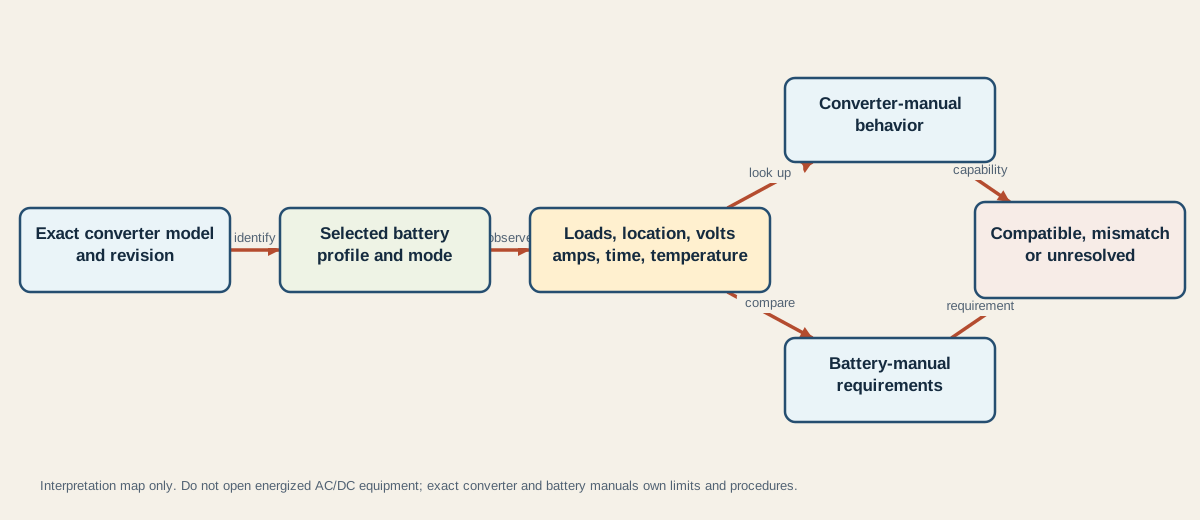
Build the evidence record in this order:
- Identity: converter or power-center manufacturer, exact model, revision, and firmware when the manual distinguishes it.
- Configuration: selected battery profile, any pendant or app mode, and whether the unit is operating as charger or fixed power supply.
- Operating state: shore/generator input state, known 12V loads, other charge sources, elapsed time, and approximate battery temperature.
- Observation: exact indicator or app label, measurement location, voltage, current if available, and time of each reading.
- Two manuals: the converter behavior that should follow from those inputs and the battery requirements that behavior must satisfy.
Progressive Dynamics’ PD9300 product documentation illustrates why configuration belongs near the start: that series offers flooded, AGM, LiFePO4, and fixed-output selections and cautions users to select the proper profile before connecting a battery. That establishes a rule for the PD9300 family, not proof that another converter detects or stores profiles the same way.
Load evidence is equally important. If a 55A converter is supplying 25A of current to active RV loads, its nameplate does not imply that 55A reaches the battery. The actual split depends on the installed system and operating limits. Record current where the manual expects it to be observed; do not infer battery current from converter rating alone.
Use the battery state-of-charge guide to keep loaded, charging, and rested readings separate. If the problem is missing charging across the path rather than stage vocabulary, move to the shore-power charging diagnostic, which owns the higher-risk test-node sequence.
Match converter behavior to battery requirements
Compatibility is a comparison, not a badge printed on one device. The converter manual tells you what the selected profile can do. The battery manual tells you what the exact battery requires and prohibits. For a named LiFePO4 pair, use the converter and lithium-battery compatibility audit to preserve exact revisions, missing constraints, and the bounded decision.
| Constraint | Converter evidence | Battery evidence | Decision rule |
|---|---|---|---|
| Normal charge voltage behavior | Setpoint or range, regulation method, and measurement location for the exact profile | Permitted absorption/charge range at the applicable temperature | Unresolved if either value or condition is missing |
| Charge current | Rated output, current limiting, and load-sharing behavior | Recommended or maximum current for the exact bank | Converter rating alone does not establish battery current |
| Completion and transition | Current threshold, timer, voltage trigger, or adaptive rule | Required completion criterion and acceptable duration | Similar stage names do not prove a match |
| Float or storage | Whether the profile floats, stores, refreshes, or supplies fixed output | Whether and how the battery may remain on continuous charge | “Float” is not automatically required or acceptable for every battery |
| Temperature | Sensor location, compensation behavior, and profile exceptions | Charge-temperature limits and compensation requirements | Block when cold/heat behavior cannot be reconciled |
| Special maintenance mode | Recondition/equalize behavior and activation controls | Exact authorization, trigger, limits, and procedure | Disabled unless both manuals explicitly support the same task |
The Lifeline AGM manual provides a concrete battery-side example: it defines constant-current bulk, constant-voltage absorption with a current-based completion criterion, lower-voltage float, and temperature-dependent values for its AGM products. Those numbers do not become universal AGM values. They show the fields that a compatible charger must be able to satisfy for that battery family.
Special modes need even tighter ownership. Victron describes recondition as an optional lead-acid stage with restrictions. Lifeline distinguishes normal charging from conditioning and notes that some chargers call a special procedure equalizing. Similar naming does not make the procedures interchangeable. Never enable recondition, conditioning, or equalization solely because a converter offers the button.
Mark the result:
- Compatible: every material converter behavior fits the exact battery requirements under the recorded conditions.
- Mismatch: a documented converter behavior conflicts with a documented battery requirement.
- Unresolved: a model, profile, setting, condition, measurement, or applicable manual is unknown.
“Unresolved” is the correct result when evidence is missing. It is not permission to choose the closest-looking profile.
Interpret common charging-stage observations
| Observation | Plausible explanation | Next bounded check |
|---|---|---|
| Converter never shows the expected boost/bulk value | Battery demand may be low, DC loads may consume output, the product may use different entry logic, or the profile may differ | Confirm exact model/profile, indicator meaning, loads, current, measurement location, and manual trigger |
| Mode remains in absorption longer than expected | Timer or adaptive logic may depend on prior bulk duration, current, load, or restart history | Compare elapsed time and current with that exact model’s transition criteria |
| Unit leaves float when a load starts | Some products intentionally restart a normal or bulk cycle after a current/load threshold | Check the documented restart trigger instead of treating any float exit as failure |
| Voltage is below a quoted stage value | The reading may be at the battery under load, not converter output; current limiting or conductor drop may also be involved | Record both named locations using an approved method and route path faults to the charging diagnostic |
| Charge current tapers while voltage is controlled | This may be expected absorption behavior for some charger/battery combinations | Check the battery completion criterion and charger transition rule; do not infer full from taper alone |
| Converter reports a lithium profile but the battery will not accept charge | Temperature protection, battery/BMS state, profile mismatch, path fault, or product limits may apply | Stop guessing from the label and consult both exact manuals and the charging-path diagnostic |
Do not diagnose a failed converter because it skipped a stage name copied from another brand. Also do not assume normal operation because an indicator cycles through three labels. Evidence must agree at the converter, battery, and operating-state levels.
The useful output of this page is not a memorized 14.xV list. It is a reproducible record: exact equipment, selected profile, visible state, loads, measurement location, voltage, current, temperature, elapsed time, converter-manual expectation, battery-manual requirement, and a result of compatible, mismatch, or unresolved.