An RV converter is not proven compatible with a lithium battery because it has a lithium label, reaches one familiar voltage, or appears to charge the battery. Compatibility means that the exact active converter profile fits the exact battery bank’s documented limits for the declared use, including voltage, time and transition logic, current, temperature, BMS control, and continuous shore-power behavior.
The correct answer is not always yes or no. A pair can be a match for one declared scope, conditionally useful with documented limits, a documented mismatch, or impossible to classify because decisive evidence is missing.
Safety and limitations: A converter can share an enclosure with lethal 120V AC, and a lithium battery bank can deliver destructive DC fault current. This page is a planning and documentation audit. Owner work stops at manuals, equipment labels and indicators that are safely visible, and controls explicitly identified as owner-operable by the exact RV and equipment manuals. Do not remove a deadfront or converter cover, move a profile switch behind a panel, disconnect a battery, alter wiring, bypass a BMS, change protection, or perform exposed or energized measurements. Configuration, installation, current verification, protection, and any access whose ownership is unclear require qualified service.
Identify the exact converter, profile, battery, and revision
Begin with identity, not chemistry. “WFCO converter,” “PD lithium converter,” and “100Ah LiFePO4” are product-family descriptions, not compatibility evidence. Similar model numbers can have different profiles, current ratings, profile selectors, or control behavior.
Build one dated record before comparing any values:
| Identity field | Record exactly | Why it changes the decision |
|---|---|---|
| RV | Manufacturer, model, model year, floor plan, and electrical modifications | The RV builder may specify a profile control, converter variant, power-center arrangement, or battery option not obvious from the converter family name |
| Converter/charger | Manufacturer, complete model and suffix, serial or production revision when relevant, output rating, and installation manual | Model suffixes can distinguish fixed, selectable, automatic, or different-current products |
| Active profile | Selected chemistry/profile and how that state was verified without unsafe access | The presence of a lithium-capable profile does not prove it is active |
| Battery | Manufacturer, complete model, heated or non-heated version, firmware if applicable, and current manual title/revision | Charge limits, cold behavior, communication, and BMS recovery can differ within a nominal capacity family |
| Complete bank | Battery count, series/parallel arrangement, nominal voltage, capacity, and whether every module is the same supported model | Bank voltage and permitted total charge current cannot be inferred from one battery label |
| Declared use | Occasional shore charging, long-term shore connection, generator charging, storage, or recovery from a protected state | The profile must be judged under the state in which it will actually operate |
| Other charge sources | Solar controller, alternator path, DC-DC charger, inverter/charger, portable charger, and tow-vehicle feed | Passing the converter audit does not approve another charging path |
| Documents | URL, observed document title/revision, and access date for both sides | Stable URLs can serve revised documents, and copied search answers can outlive a product revision |
If the unverified source is the alternator path, use the RV DC-DC charger candidate audit separately. It blocks candidate-only when vehicle headroom, battery limits, charger behavior, or either current path lacks evidence; a passing shore converter does not satisfy those gates.
Airstream’s converter support page illustrates the model problem. It documents different profile controls for named WFCO and Progressive Dynamics equipment installed in particular trailers, including controls behind a faceplate for some arrangements. That source does not authorize access in another RV. If the profile state cannot be confirmed through an owner-facing indicator or an explicitly permitted procedure, record it as unknown and route confirmation to qualified service.
The manual record also needs a freshness note. On August 28, 2026, the current Battle Born URL used in this audit contains an older-looking filename but resolves to a document titled “100Ah 12V Standard Battery Manual, Rev038.” The observed title is the evidence; the URL text is not a reliable revision field. Recheck after a manual, firmware, battery-bank, converter, or profile change.
Use the converter-versus-inverter guide if the installed box’s function is uncertain. Use the battery-bank topology guide before this audit if bank voltage, capacity, or module arrangement has not been established.
Compare both manuals constraint by constraint
The converter manual defines what the selected profile does. The battery manual defines what the bank allows or requires. Neither document can answer for the other.
| Constraint | Converter-side evidence | Battery-side evidence | Decision rule |
|---|---|---|---|
| Nominal system voltage | Exact supported DC system and profile | Exact battery-bank nominal voltage and permitted configuration | A different nominal system voltage is a mismatch |
| Charge/absorption voltage | Setpoint or regulated range at the named profile | Permitted range under the applicable conditions | A numeric overlap is necessary but not sufficient |
| Duration and exit logic | Timer, current threshold, voltage trigger, adaptive rule, restart behavior, and measurement ownership | Required or permitted absorption time and balancing opportunity | Similar stage names do not prove the algorithms agree |
| Idle, float, storage, or refresh | Continuous value, periodic refresh, and events that restart charging | Permitted continuous-charge range and any storage restrictions | Classify the complete cycle, not only the highest voltage |
| Equalize, recondition, or temperature compensation | Whether the mode exists, can activate automatically, or can be disabled | Explicit permission or prohibition for the exact battery | A prohibited mode is a mismatch unless it is verifiably disabled as documented |
| Converter output current | Exact model rating, current limit, and whether output also serves RV DC loads | Recommended and maximum charge current for the complete bank | Nameplate output is not a battery-current measurement; both limit and installed split must be resolved |
| Charge temperature | Converter sensing, compensation, inhibit, or lack of control | Battery charge-temperature range and cold/hot protection behavior | A lithium profile does not prove temperature permission |
| BMS relationship | Whether the charger accepts a charge-disable signal or communicates with the required BMS | Internal/external BMS requirements and charger-control method | The BMS is protection/control evidence, not permission to use a mismatched profile |
| Wiring and protection | Required DC conductor, connection, fuse/breaker, disconnect, ventilation, and installation constraints | Battery fault-current, connection, enclosure, and protection requirements | Compatibility stays unresolved until the installed path is verified |
| Recovery states | Converter behavior when battery voltage is absent or the BMS has disconnected charging | Manufacturer-approved recovery and support procedure | Do not improvise a wake-up or bypass from a generic guide |
The PD9300 LiFePO4 profile is a useful converter-side example because it publishes more than one voltage. It defines a charge mode, the current/time conditions that lead to idle, continuous idle behavior, a periodic refresh, and the fact that the converter also supplies RV DC power. The converter charging-stages guide explains why those algorithm fields matter more than a generic bulk/absorption/float vocabulary.
Battery manuals vary substantially. The current Battle Born BB10012 manual specifies product-level voltage, current, absorption time, temperature, balancing, and internal-BMS behavior. Victron’s Lithium Battery Smart operation manual specifies a different set of charger parameters, while its BMS system-design chapter makes charger control by an approved BMS part of the system design. These are not interchangeable “LiFePO4 settings.”
Do not use a BMS cutoff as the normal charger transition. A BMS that blocks charge for cell voltage or temperature is protecting the battery at a boundary. It does not prove that an upstream charger profile, current, or recovery behavior is acceptable. Repeated disconnect/reconnect behavior is a reason to preserve the state and consult the exact support path, not to bypass protection.
Current also requires disciplined wording. A 45A converter cannot deliver more than its documented output rating, but that does not prove 45A reaches the battery. Active 12V loads may consume some output, wiring can limit delivery, and another charge source can add current at the bank. Conversely, a higher-rated converter may exceed a single battery’s documented limit under some conditions. Qualified verification must measure the correct path under the manual-defined state; the converter label is only one constraint.
Run the compatibility gates
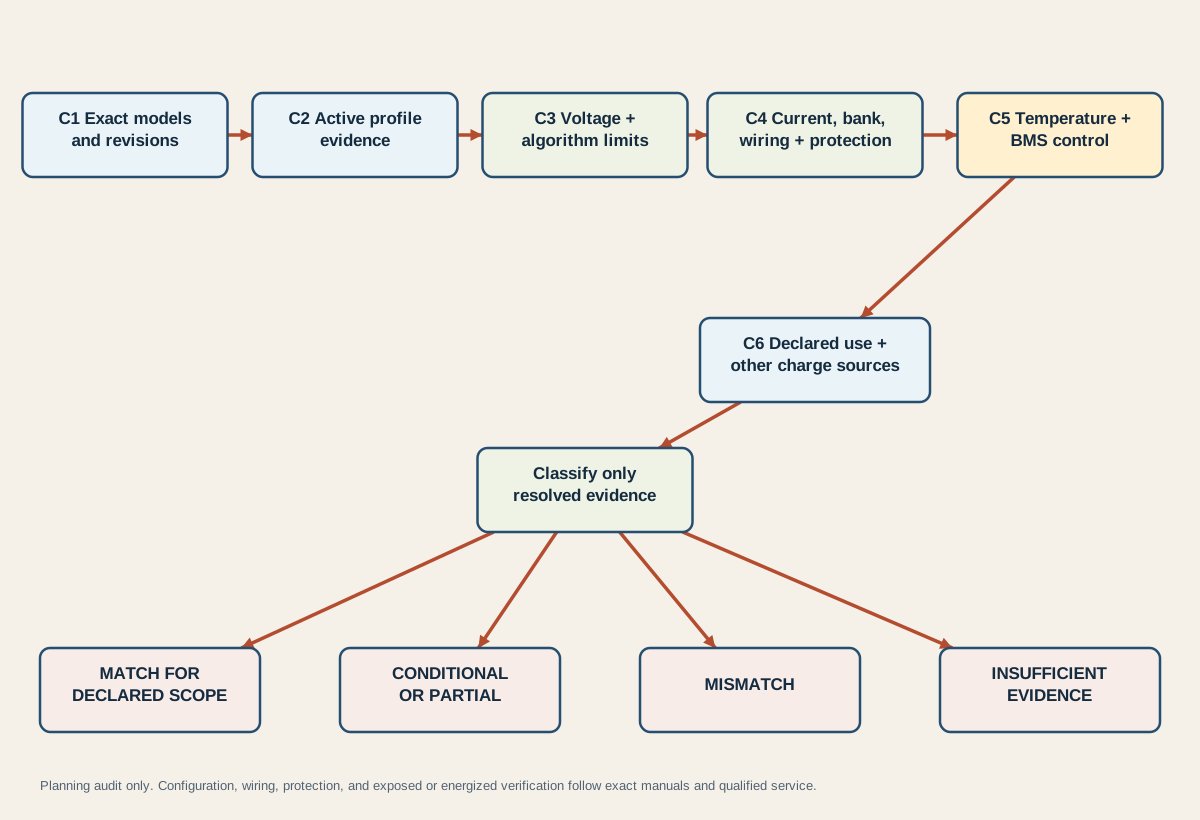
Use the diagram as an evidence checklist, not as a wiring diagram.
| Gate | Pass condition | Failure or unknown result |
|---|---|---|
| C1 exact models and revisions | Converter, battery, complete bank, and current documents are identified | INSUFFICIENT EVIDENCE if any decisive identity is missing |
| C2 active profile evidence | The active profile is confirmed through a documented, safely accessible method | INSUFFICIENT EVIDENCE if capability exists but selection cannot be verified |
| C3 voltage and algorithm limits | Charge, transition, idle/float, refresh, compensation, and special-mode behavior fit the battery manual | MISMATCH for a documented conflict; otherwise INSUFFICIENT EVIDENCE |
| C4 current, bank, wiring, and protection | Bank-level current limits and the installed path are verified for the declared state | CONDITIONAL OR PARTIAL when a bounded use is supported but installed-current evidence remains; MISMATCH for a documented exceeded limit |
| C5 temperature and BMS control | Charging is inhibited or controlled exactly as the battery system requires | MISMATCH for a missing required control; INSUFFICIENT EVIDENCE when behavior is undocumented |
| C6 declared use and other charge sources | The result names its operating scope and every other source has a separate owner | A converter result cannot approve solar, alternator, DC-DC, or another charger |
The four final states mean:
- MATCH FOR DECLARED SCOPE: Every material constraint is documented and agrees for the named equipment, bank, configuration, condition, and use. It is not a universal approval outside that scope.
- CONDITIONAL OR PARTIAL: The documents support a bounded use or performance expectation, but one or more non-conflicting system conditions still constrain charging completeness, time, current, monitoring, or operation.
- MISMATCH: A documented converter behavior conflicts with a documented battery or system requirement. Do not rely on the battery BMS to make the conflict acceptable.
- INSUFFICIENT EVIDENCE: A decisive identity, profile, revision, algorithm field, limit, installed-path fact, or control behavior is missing. Unknown is not a softer version of compatible.
A failed C3 or C5 cannot lead to MATCH FOR DECLARED SCOPE. An unknown C1 or C2 cannot be repaired by observing that the battery percentage rises. A normal-looking charge indication is operational evidence only; it does not identify the profile, validate temperature control, or prove the complete cycle.
If a real charging symptom exists, such as no battery-current acceptance on shore power, use the shore-power charging diagnostic after this compatibility record is complete. That page owns the source-to-battery test-node path. This page owns only the converter/battery constraint decision.
Interpret a dated worked example and choose the next action
The following example is a documentation exercise observed on August 28, 2026. It is not a product endorsement or approval for an unseen installation.
Declared pair: Progressive Dynamics PD9345, its documented LiFePO4 profile selected, and one Battle Born BB10012 battery using the current Rev038 manual. Declared use: charging the house battery from accepted shore power while also supplying ordinary RV 12V loads. Wiring, protection, ambient/battery temperature, profile-selection access, modifications, and actual battery current are not supplied.
| Constraint | PD9345 lithium-profile evidence | BB10012 Rev038 evidence | Bounded result |
|---|---|---|---|
| Identity and rating | PD9300 product page lists PD9345 as a 45A model | Manual identifies the 12V 100Ah BB10012 family and relevant variant distinctions | Exact product families are identified; installed suffix, unit state, and battery variant still need field confirmation |
| Charge voltage | Profile publishes 14.4V charge mode | Manual permits a 14.2V to 14.6V absorption range | Documented voltage overlap |
| Idle/float behavior | Profile publishes continuous 13.6V idle with defined restart/refresh behavior | Manual permits a 13.4V to 13.8V float range | Documented idle-voltage overlap; full behavior still includes refresh and transition logic |
| Duration and transition | Profile uses current/time behavior and an eight-hour maximum charge-mode limit | Battery manual publishes its own absorption-time guidance and balancing behavior | Not enough evidence here to declare the two time/exit models fully equivalent; manufacturer confirmation may be needed for the intended duty cycle |
| Current | Converter model rating is 45A and output also serves RV DC loads | One battery has a documented recommended/max charge-current field, with 50A shown as the maximum | Nameplate ceiling does not exceed that battery maximum, but actual bank current, other sources, loads, wiring, and protection remain unverified |
| Temperature and BMS | The converter profile document does not by itself establish battery-temperature sensing or charge-disable communication | Battery manual documents internal temperature protection and BMS behavior | Internal protection exists, but it is not proof of charger-side control or permission to ignore temperature conditions |
| Other sources | Converter document owns AC-to-DC charging only | Battery sees total bank current from every active source | Solar, alternator, DC-DC, inverter/charger, and portable sources remain separate audits |
Result: CONDITIONAL OR PARTIAL. The observed documents support voltage overlap, and the PD9345 nameplate ceiling does not exceed the manual’s listed maximum for one BB10012. They do not prove the installed profile state, actual current split, combined-source current, path capability, temperature condition, exact battery variant, or full equivalence of the published time/transition behavior. Those unknowns prevent MATCH FOR DECLARED SCOPE. No documented conflict in the compared voltage windows produces MISMATCH either.
This result would change if the exact model changed. The PD9300 product page lists other family members with different output ratings. A larger bank can also change the permitted total current, while series/parallel rules and module limits remain battery-manual decisions. Never transfer the PD9345/one-BB10012 result to a PD9360, PD9380, another battery model, or a multiple-battery bank by analogy.
| Your audit result | Appropriate next action | Do not infer |
|---|---|---|
| MATCH FOR DECLARED SCOPE | Retain the record with exact revisions, configuration, conditions, and recheck triggers | Approval for other sources, future manuals, another bank, or installation changes |
| CONDITIONAL OR PARTIAL | Decide whether the documented limitation fits the actual use; obtain manufacturer or qualified-system confirmation for unresolved installed conditions | That “it charges” means it will reach the intended completion state safely in every mode |
| MISMATCH | Keep the mismatched mode out of service and plan a manual-compliant configuration or equipment change with qualified help | That a BMS cutoff, lower usage, or periodic manual reset cures the conflict |
| INSUFFICIENT EVIDENCE | Obtain exact labels, current manuals, configuration state, and manufacturer support before retaining or replacing equipment | That the newest, largest, or lithium-labeled replacement will fit wiring, protection, space, or the rest of the system |
Replacement is therefore not the automatic answer. A documented existing pair may be retained for its declared scope. A configurable unit may require the exact authorized profile procedure. A true mismatch may require a different charging strategy. An unidentified unit requires evidence before a purchase decision. Any installation change must also pass the power-center and protection ownership guide and the exact conductor, fuse/breaker, ventilation, mounting, and code requirements.
Save the final audit with the date, models, observed manual revisions, active profile evidence, bank configuration, every compared constraint, open issues, result, and recheck triggers. Reopen it whenever a battery is added, a profile or firmware changes, another charge source is enabled, a manual is revised, or the operating scope changes. Compatibility is a maintained evidence record, not a permanent sticker.