
An RV power center may place 120V AC breakers, 12V DC branch fuses, and a converter/charger in one enclosure. Their physical proximity does not make them one electrical path. A breaker can leave one AC branch dead while the 12V system still works; a DC fuse can interrupt one 12V load without affecting receptacles; converter protection can affect charging without owning every battery-fed circuit.
Use this page to identify those functions and assign a symptom to the right protection owner. Do not use a generic panel photo as a pinout, copy a fuse value from another RV, or assume an indicator light proves which component failed.
Safety and limitations: RV power centers can contain lethal 120V AC, while a house battery can deliver very high fault current even when shore power is disconnected. Limit owner inspection to documentation, externally visible labels and indicators, and access specifically permitted by the exact RV and equipment manuals. Isolate every source with the installed controls before any manual-approved fuse check. Do not remove an energized cover, bypass protection, upsize a fuse, or repeatedly reset or replace an opening device. Heat, odor, discoloration, water exposure, damaged conductors, uncertain isolation, or a device that opens again requires qualified service.
Map the power-center functions
Start with functions, not cabinet position. A power center is an assembly that may combine multiple functions. A distribution panel routes power into protected branches. A converter/charger changes accepted AC into DC that can support 12V loads and charge the house battery. A protective device opens a particular path under defined fault or overcurrent conditions.
The Progressive Dynamics PD4500 manual documents one combined product family with AC distribution, DC distribution, and converter functions. The WFCO WF-8712 page documents another combined power center with model-specific AC and DC capacity. These examples establish that combination is possible; neither layout can identify an unknown RV.
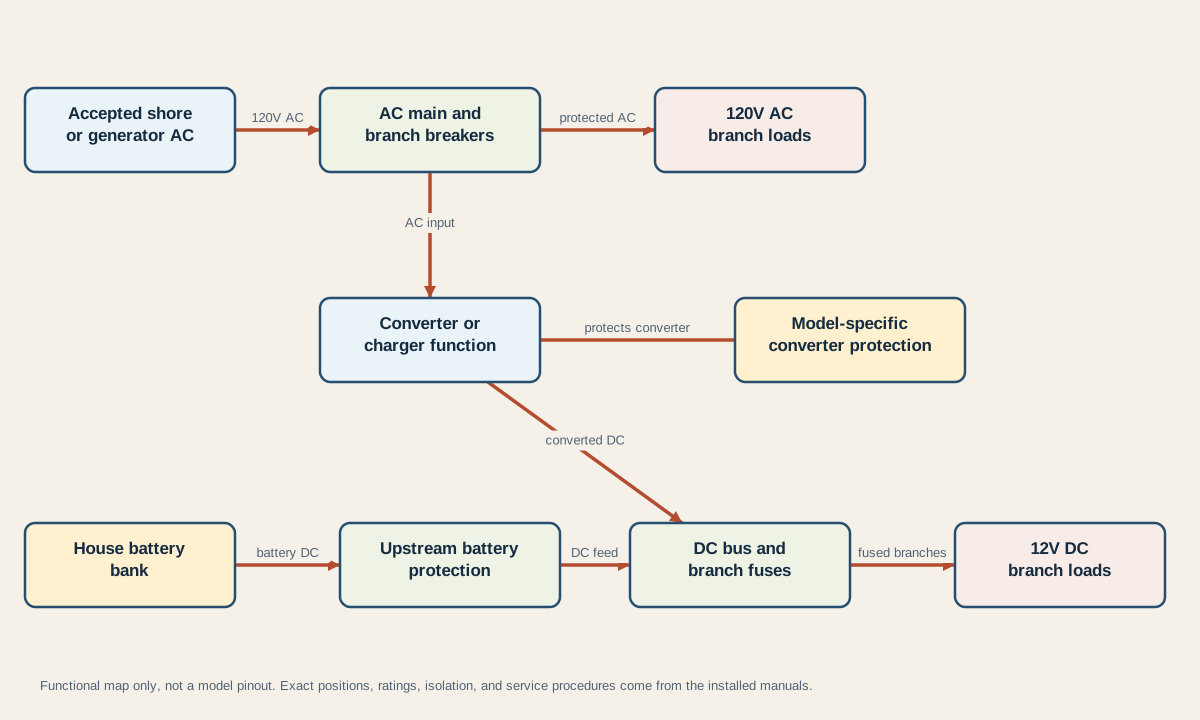
The map is functional, not physical. Follow its paths separately:
- Accepted shore or generator AC reaches the AC main and branch breakers. Protected AC branches serve connected 120V loads and may also feed the converter.
- The converter produces DC under its documented operating conditions. Its output can support the DC distribution bus and battery-charging path, but its exact relationship to the battery depends on the installed design.
- The house battery can feed the DC bus through upstream battery protection. That path can remain energized when shore power is absent unless the installed disconnect and isolation procedure say otherwise.
- DC branch fuses protect the wiring paths to individual 12V loads. Converter reverse-polarity or product protection serves a different, model-specific purpose.
Victron’s DC wiring reference illustrates the general protection hierarchy: a battery-fed system can have main protection near its source and separate protection for downstream circuits. The fuse protects its assigned wiring path from excessive current; it is not a universal on/off label for everything located nearby.
If these source, conversion, distribution, and load roles are unfamiliar, read the RV electrical system overview first. The converter-versus-inverter guide separates equipment functions that are frequently confused with the panel itself.
Read labels and indicators in context
Before interpreting a fuse row, build an identity record. A clear photo taken with the enclosure closed or through only the owner-access area permitted by the manual can preserve labels without turning observation into live electrical work.
| Record | What to capture | Why it matters |
|---|---|---|
| RV identity | Make, model, model year, floor plan, and factory or documented modifications | Two visually similar RVs can use different equipment or branch assignments |
| Power-center identity | Manufacturer, exact model, revision, and serial information when available | Branch capacity, indicator behavior, and service access are model-specific |
| Documentation | Exact manual revision and the RV’s circuit directory | A generic search result cannot assign the installed positions |
| Circuit label | Printed directory text and slot or fuse position exactly as shown | Labels are evidence to verify, not proof that later modifications preserved the assignment |
| Protective device | Breaker or fuse type and every legible marking, without removal unless the manual permits it after isolation | Appearance alone does not establish type, rating, condition, or correct application |
| Operating state | Shore/generator state, battery disconnect state, affected loads, visible indicator state, heat, odor, or damage | The meaning of an indicator can depend on whether its circuit is energized |
Indicator features are not universal. WFCO describes an LED indication for open DC circuits on the WF-8712. Progressive Dynamics documents blown-fuse indication as an available feature within the PD4500 family and gives model-specific logic. An LED that is off may mean no open fuse, no power to the indicator circuit, a different product implementation, or another state defined by that manual. An LED that is on is a clue to verify under the exact manual, not permission to grab the nearest same-color fuse.
A fuse element can also be difficult to judge visually. When the exact manual permits an owner check, first follow its complete isolation procedure, then use its specified verification method. If replacement is allowed, the PD4500 manual directs replacement with the same type and rating. That is a replacement rule, not a sizing method. Selecting protection for a new or modified circuit belongs to the RV 12V fuse candidate checker, which separately audits conductor, equipment, environment, interrupting capability, placement, and applicable-requirement evidence.
Classify the protection before acting
The useful question is not “Which fuse is closest?” It is “Which current path does this device protect?” Use the installed manuals to match each device to one of these roles.
| Protection role | Path it owns | What an open device can affect | What it does not prove |
|---|---|---|---|
| AC main or branch breaker | Incoming AC or a named 120V branch | All accepted AC downstream of a main, or the receptacles/appliances on one branch | That the battery is discharged, a DC branch fuse is open, or the converter itself failed |
| DC branch fuse | DC bus to one named 12V branch | One light, pump, control circuit, or group assigned by the directory | That the converter cannot charge, the upstream battery path is intact, or the fuse value is correct |
| Converter reverse-polarity or internal protection | A converter-specific path documented by its manufacturer | Converter output or operation under the conditions described by that manual | That every battery-fed 12V branch must be dead, or that the device is owner-serviceable |
| Upstream battery fuse or breaker | Battery source to downstream conductors or distribution | Multiple battery-fed DC loads downstream of that point | That shore-powered AC branches are unavailable, or that a branch-level fault is absent |
| Equipment-local fuse | The protected path inside or immediately feeding one appliance or accessory | That equipment or its local feed | That a similarly named panel branch is the only possible cause |
More than one protection layer may exist in a path. For example, Progressive Dynamics distinguishes converter reverse-battery protection from an inline battery fuse in its installation documentation. Treating those as interchangeable can send diagnosis to the wrong location and leave another energy source unaccounted for.
Do not increase a fuse rating because a replacement opens. A second opening is evidence that the fault or load condition remains; it is not evidence that the circuit “needs a bigger fuse.” Stop, preserve the exact state and device markings, and have the path evaluated against its conductor and equipment requirements. Likewise, a breaker that will not remain set, a loose-feeling device, heat, odor, or discoloration is a stop condition, not a repeated-reset experiment.
Route the symptom to the right owner
Once the panel functions and device ownership are documented, use the scope of the failure to choose the next diagnostic owner. This avoids repeating high-risk procedures inside a basic reference page.
| Observed scope | Likely owner to investigate (not a diagnosis) | Safe evidence to collect | Canonical next step |
|---|---|---|---|
| One 12V light, pump, or accessory branch is dead while other 12V loads work | That load, its switch/control, connection, local protection, or named DC branch | Exact affected loads, directory label, accessible indicator state, and when the failure began | RV 12V power not working |
| Most or all 12V loads are dead | Battery disconnect/path, upstream DC protection, DC bus, converter contribution, or a shared connection | Whether loads fail on battery and accepted shore power, battery monitor state, converter indicator, heat/odor/damage | RV 12V power not working |
| 12V loads work, but the battery does not appear to charge on accepted shore power | Converter input/output path, charging configuration, battery path, or measurement interpretation | Exact converter and battery identities, source state, load state, and time-stamped readings available without hazardous access | RV battery not charging on shore power |
| One or more 120V receptacles or appliances are dead | AC source, transfer path, main/branch breaker, GFCI device, or downstream AC circuit | Which AC loads work, source and pedestal state, visible damage, and owner-visible breaker/GFCI state | RV shore-power safety check before qualified AC troubleshooting |
| A fuse or breaker opens again, or the panel is hot, wet, discolored, damaged, or smells burned | Active fault or unsafe equipment condition | Stop using the affected source; record only what is visible without opening equipment | Qualified RV electrical service; do not continue a generic checklist |
This routing matrix identifies ownership, not cause. A single dead 12V load does not automatically mean a fuse failed. All 12V loads going dark does not automatically condemn the converter, because the battery and converter can reach the DC bus through different paths. A charging complaint does not automatically belong to the DC branch-fuse row, and an AC complaint does not become safe because the breakers share a cabinet with low-voltage fuses.
The practical endpoint is a compact evidence packet: RV and panel identity, exact manuals, source states, affected and unaffected loads, circuit directory, visible indicator state, time sequence, and any stop condition. That packet makes the next diagnostic safer and more specific while keeping a model-neutral explanation from becoming an unsafe universal wiring guide.