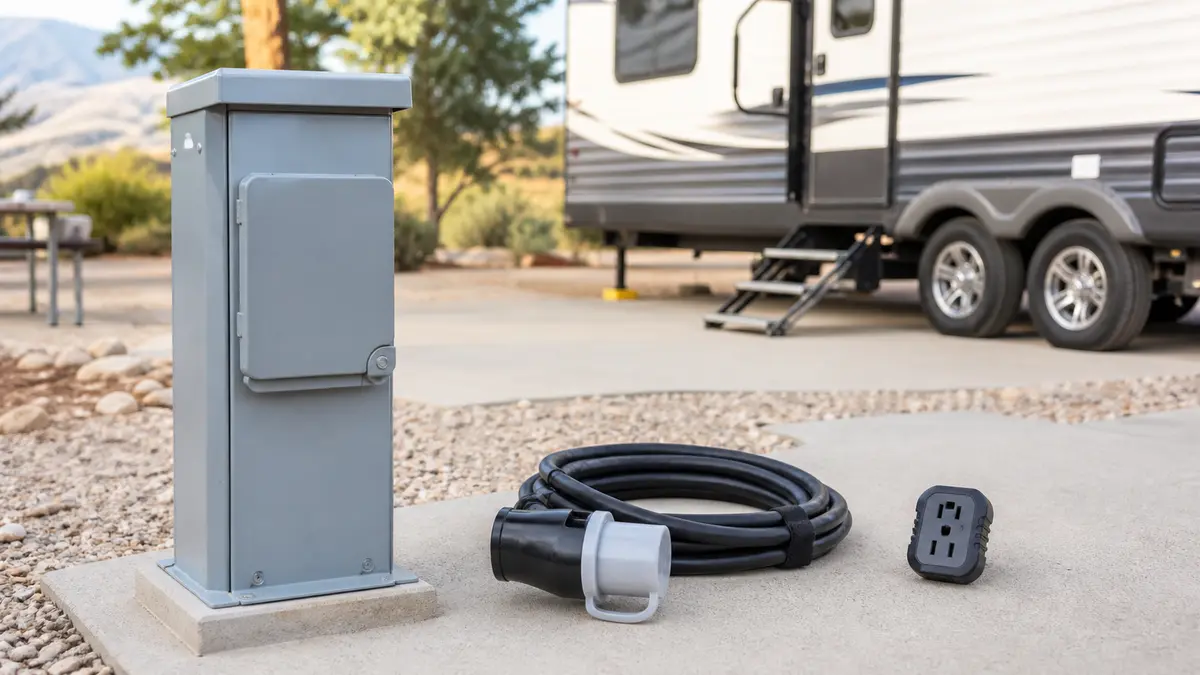
Do not connect an RV to shore power when the receptacle, pedestal, cord, plug, inlet, adapter, or external tester shows damage or a fault. A normal-looking connector and a “correct” tester indication reduce uncertainty; neither one proves the entire pedestal, cord, RV, neutral, ground path, transfer equipment, or branch system safe.
This checklist is deliberately external. It does not teach multimeter probing, pedestal disassembly, panel work, neutral/ground correction, or fault bypassing. First confirm whether the source is 30A or 50A RV service and use only compatible, listed equipment whose instructions you have.
High-risk safety boundary: Keep pedestal and RV enclosures closed. Do not touch an RV that may have energized metal, stand in water while handling electrical equipment, defeat a ground or protective device, or repeatedly reset a fault. If anyone feels a shock or tingling sensation, move away without touching the RV again, have the source de-energized by responsible personnel, and obtain qualified emergency/electrical help appropriate to the situation.
Inspect before connecting
Begin with the campground source breaker off, if it is an owner-accessible breaker intended for normal operation, and the RV main breaker off. Do not remove a pedestal cover to verify that it is off. If the source cannot be placed in the documented connection state, stop and ask campground staff.
Inspect only what is visible without opening equipment:
| External observation | State | Owner action |
|---|---|---|
| Correct service type; pedestal and receptacle are dry, intact, stable, and free of discoloration; cord, plug, inlet, and any adapter are intact | Proceed to the compatible-tester check | Keep the source off until the exact tester or protection-device instructions say otherwise. |
| Cracked housing, missing cover, loose receptacle, corrosion, charring, melted plastic, bent or missing contact, cut insulation, exposed conductor, or evidence of arcing | Do not connect | Photograph only from a safe distance if useful; report the site to campground staff. Do not straighten, clean, tighten, or repair it. |
| Plug or receptacle was hot, smells burned, buzzes, arcs, or intermittently loses power | Disconnect and escalate | If safe to operate normally, turn the source off before disconnecting. Keep the site out of service pending qualified evaluation. |
| Standing water, active rain entering equipment, unstable pedestal, or uncertain source identity | Do not connect | Move to a suitable site or wait for campground staff to make the condition safe. |
| Adapter or extension equipment has an unknown rating, missing listing/markings, damage, or a configuration not approved by the RV and equipment manuals | Do not connect | Replace it with documented compatible equipment; do not use connector fit as evidence of capacity or safety. |
The RV Industry Association’s GMI guidance names physical damage, overheating, corrosion, and looseness as visible conditions that can compromise the safety-ground path. The Jayco 2026 towable manual likewise instructs owners to inspect shore cords for cuts, cracks, and worn insulation and not connect when a monitor indicates reverse polarity or open ground.
“Looks good” means only that this external inspection found no visible stop condition. Continue to a compatible device check; do not convert a visual pass into permission to work inside the pedestal.
Interpret an external circuit tester
Use a circuit analyzer, energy-management system, surge protector, or other external protection device only for the service type, location, and sequence allowed by its exact manual. Different products detect different fault sets and display them differently. Do not copy an indicator legend from a different model.
| Device state | Meaning within this checklist | Safe next action |
|---|---|---|
| Open ground, reverse polarity, open neutral, missing leg, miswired source, high/low voltage, elevated ground current, or another documented blocking fault | The device found a condition it is designed to report | Do not connect, or disconnect if the device has already removed power. Record the exact code and model; give both to campground staff or a qualified electrician. |
| Unknown code, conflicting lights, no display when one is expected, cycling, chatter, repeated delay, or behavior not explained by the manual | The result is not interpretable from available evidence | Do not connect. Do not guess, bypass the device, or substitute a forum legend. |
| Device reports normal/correct within its documented scope | The tested conditions passed at that moment | Proceed only if the external visual check also passed. Continue monitoring; this is not proof of every possible fault. |
| GMI or protection device refuses to energize the RV | The protection state is doing its job until proven otherwise | Keep it in the safe state. Do not bypass or defeat it to “see if the RV works.” |
Southwire’s 44270 product documentation is one manufacturer example: that device category identifies open ground, open neutral, and polarity status. It is not a universal legend for other models. RVIA explicitly cautions that plug-in testers provide only a partial answer compared with broader grounding-monitor functions.
“Hot skin” describes energized metal on the RV caused by an electrical fault or grounding problem. It is a serious shock hazard, not a symptom to confirm by touch. An open-ground or polarity indication is therefore a stop state, even if lights or appliances seem to operate.
If the source passes this external preconnection screen but you need to distinguish equipment ground, neutral, chassis, earth, and the source-dependent neutral bond, use the RV grounding and bonding evidence map. It explains bond ownership without turning a tester result into permission to add a jumper or bonding plug.
Connect and disconnect without bypassing a fault
Only enter this section after the external visual check and the device-specific check have passed. The fixture-driven flow keeps the safe states visible:
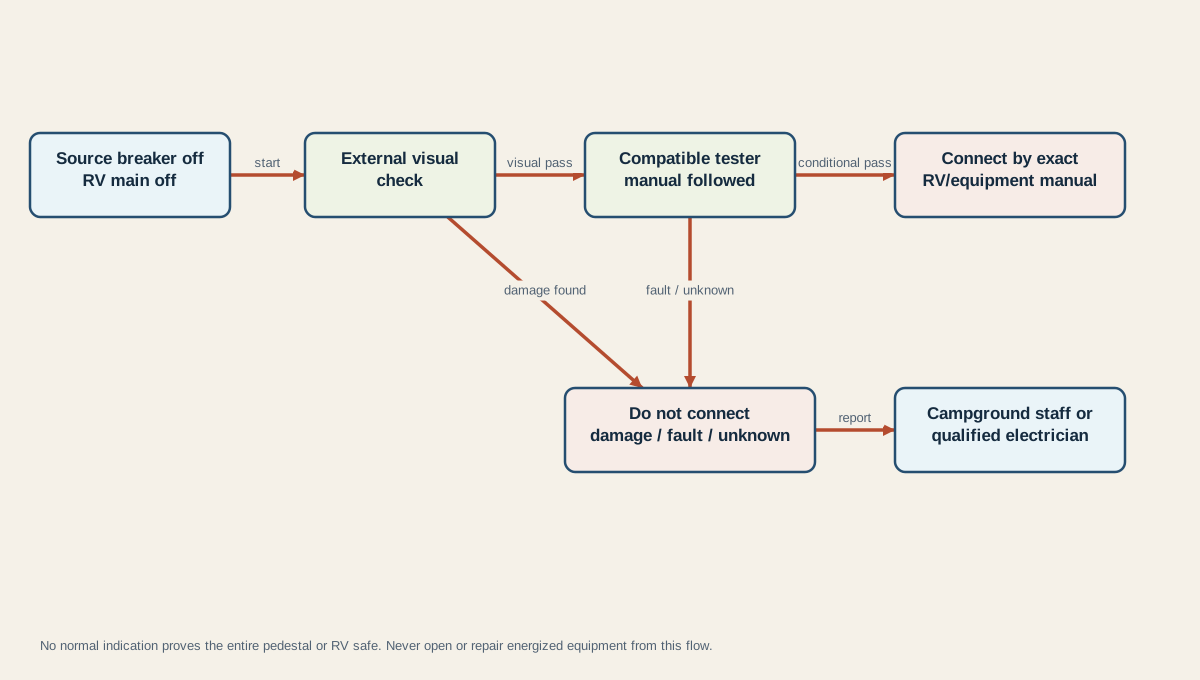
Use the exact RV and equipment manuals as the source of truth. A manufacturer sequence such as the Jayco manual’s can be summarized without exposing live parts:
- Turn off the RV load-center main breaker and the external source breaker when those controls are intended for owner operation.
- With the source off, fully seat and secure the correct cord at the RV inlet as its manual specifies. Do not force, modify, or partially engage a connector.
- Route the full cord so it is not stretched, pinched, submerged, driven over, or creating a trip hazard.
- Fully seat the correct plug in the matching source receptacle. Do not use an adapter to conceal a service mismatch or fault.
- Enable the source and RV main only in the sequence specified by the installed manuals. Observe the protection device through any required delay.
- If a fault appears, power is unstable, a breaker repeatedly trips, or any connection develops heat, odor, discoloration, buzzing, or arcing, turn off the source using its normal control if safe, disconnect according to the manual, and escalate.
For departure, use the documented reverse sequence: loads and breakers off as specified, source off, grasp the plug body rather than pulling the cord, then release the RV inlet connection. Reinspect the cord and connectors before storage. A new heat mark or looseness is evidence, not normal wear to ignore.
Report a fault with the campsite number, service type, tester/protection-device manufacturer and exact model, displayed code or lights, whether the fault occurred before or after the RV was connected, and any visible heat or damage. Do not report a diagnosis you did not verify.
After a safe source connection is established, a separate failure such as a house battery that does not charge belongs in the shore-power battery charging test sequence. This page owns only the owner-visible pre-connection and stop/escalation task.
Last verified: August 27, 2026. Tester functions, indicator meanings, RV connection sequences, and electrical requirements vary by product, RV, campground, and jurisdiction.