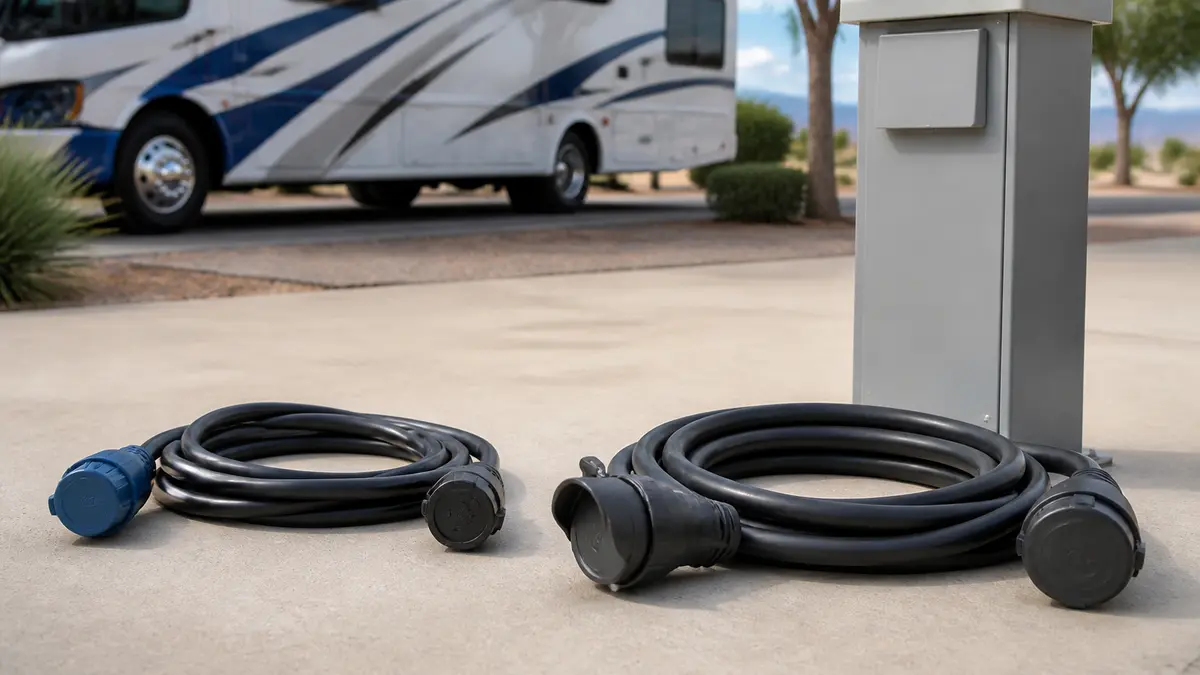
The headline math is simple: 30A at 120V is 3,600 watts; typical North American 50A RV service is two 120V legs, up to 6,000 watts per leg and 12,000 watts total. The second number is not permission to put a 240V appliance on every RV. It describes the supply and the way ordinary 120V branch loads can be distributed.
This page is a service-capacity comparison, not a pedestal or panel wiring procedure. Start with the RV electrical system overview if source, bus, and load terms are unfamiliar.
Safety boundary: Do not open an energized pedestal, inlet, panel, transfer switch, or adapter. A connector that fits does not prove correct polarity, grounding, breaker protection, or compatibility. Use the RV, pedestal, adapter, and equipment manuals; stop and obtain qualified help when a ground, neutral, heat, odor, arcing, or breaker problem is present.
30A and 50A RV power compared
The comparison below shows service ratings, not the guaranteed simultaneous wattage of every appliance in a particular RV. Actual usable capacity is constrained by the pedestal breaker, RV main breaker, wiring, appliance controls, and the lowest-rated component.
| Service | Supply relationship | Simple rating math | What the number means |
|---|---|---|---|
| 30A RV service | One 120V hot leg plus neutral and equipment ground | 120V × 30A = 3,600W | One 120V service path; loads share the same headline limit. |
| 50A RV service | Two 120V hot legs, neutral, and equipment ground; 240V exists between hots | 120V × 50A × 2 = 12,000W | Up to 6,000W on each leg in the service model; ordinary RV branches are normally 120V. |
Cummins’ RV power basics uses volts × amps for the same headline calculation and cautions that breaker, configuration, and wire size still matter. A 50A cord therefore gives an RV more service capacity, but not an unlimited load budget. Two air conditioners, a water heater, a microwave, and receptacle loads can still exceed a breaker or an appliance control limit when they operate together.
The practical verdict is capacity, not connector prestige. If an RV is built for 30A, feeding it from a 50A pedestal through a listed, correctly rated adapter does not turn its inlet, main breaker, or branch wiring into a 50A system. Conversely, a 50A RV connected to a 30A source must be managed as a 30A load.
Why 50A service has two 120V legs
The phrase “50A RV service” causes confusion because the source arrangement can be described as 120/240V while the RV’s ordinary branch circuits use 120V. The distinction is about which conductors are measured together:
- Each hot leg to neutral is about 120V in the typical North American service model.
- The two hot legs measure about 240V from hot to hot.
- A 120V branch circuit uses one hot leg and neutral; it does not automatically become a 240V circuit.
- The two 50A ratings are capacity on separate legs. They are not 100A at one 120V receptacle.
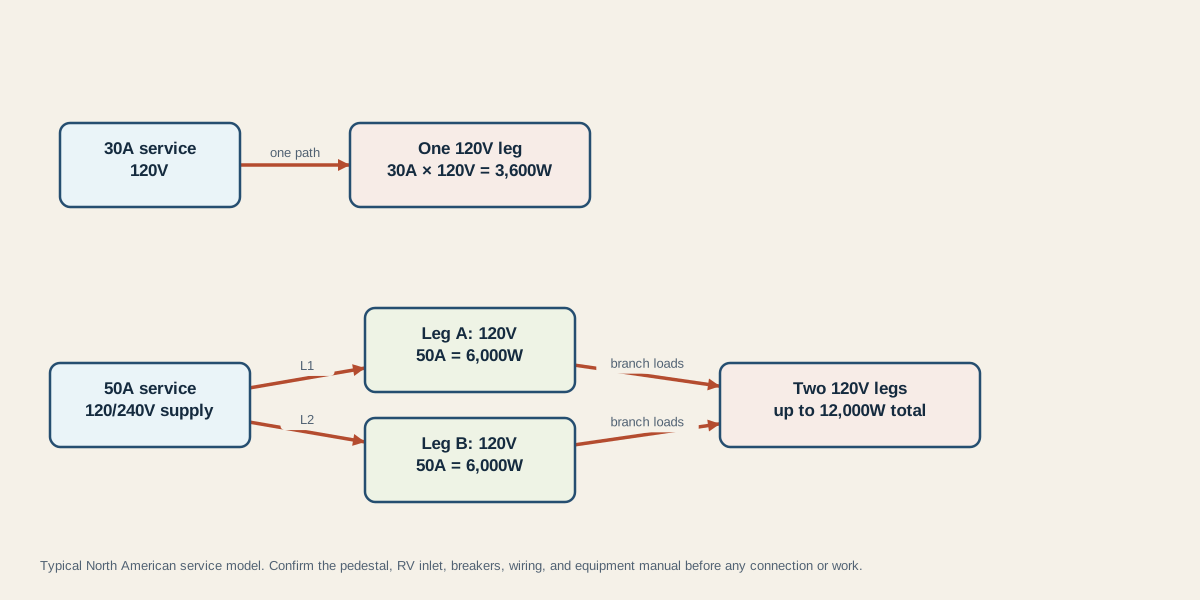
The diagram is generated from one fixture so its labels and math stay aligned. It intentionally omits terminal positions, wire gauges, breaker spaces, neutral bonding, and grounding instructions. Those details belong to the exact RV and equipment documentation. The Jayco owner’s manual is an example of why model documentation matters: service equipment and owner limits are specified for a particular RV, not for every trailer with a similar connector.
Load balancing is therefore a distribution question. If one leg has a large air-conditioner load while the other is lightly loaded, the lightly loaded leg does not donate its unused current to the first leg through ordinary 120V branch wiring. If a breaker, neutral, ground, or inlet shows heat or damage, turn off the source and stop; do not “test” by repeatedly resetting it.
What a shore-power adapter changes
An adapter changes the physical connection between a source receptacle and an RV cord. It does not create a larger breaker, new conductors, a second hot leg, or a different RV main panel. Use this state table before assuming an adapter solves a capacity problem.
| Source → RV connection | RV sees in practice | What remains unavailable or limited |
|---|---|---|
| 50A pedestal → 30A RV with a listed 50-to-30 adapter | A 30A RV inlet supplied from a larger source | The RV inlet and 30A main remain the limit: plan around 3,600W. |
| 30A pedestal → 50A RV with a listed 30-to-50 adapter | A 50A cord connected to a single 30A source path | The source remains 30A; do not assume both RV legs can deliver 50A each. |
| 15/20A household receptacle → RV adapter | A small branch circuit, if the receptacle and adapter are suitable | The household breaker and receptacle rating are the limit; high continuous loads may be unsuitable. |
| Damaged, hot, wet, loose, or unverified connection | An unsafe condition | Stop. Fit is not evidence of correct polarity, grounding, or protection. |
The RV Industry Association’s grounding monitor guidance describes equipment-ground continuity as a safety concern. That is why a “dogbone” adapter should be listed and intact, and why an adapter should never be used to defeat a missing ground, a tripped protection device, or a hot connection. The adapter can solve a plug-shape mismatch; it cannot repair the shore-power system.
For diagnosis, record the source receptacle type, pedestal breaker, RV inlet rating, adapter markings, measured symptoms, and which loads were operating. Then compare that record with the exact RV manual. Before using an unfamiliar campsite source, follow the RV shore-power safety check. For a battery that does not charge after a safe shore connection is established, continue with RV battery not charging on shore power. For component roles, see RV converter vs inverter.
This page owns the 30A/50A service comparison and adapter boundary. It does not size branch circuits, approve an installation, or replace an electrician’s inspection.
Last verified: August 27, 2026. Service ratings and permitted equipment vary by RV, campground, jurisdiction, and manufacturer manual.